I have always been passionate about Asia and photography, and what better opportunity to combine these two interests than my bachelor degree thesis?
This decision was solidified during my internship at Ikonemi, a photography center where I engaged with photographers and explored the hidden aspects of photography: the ideas, stories, and emotions that each photographer conveys through their work.
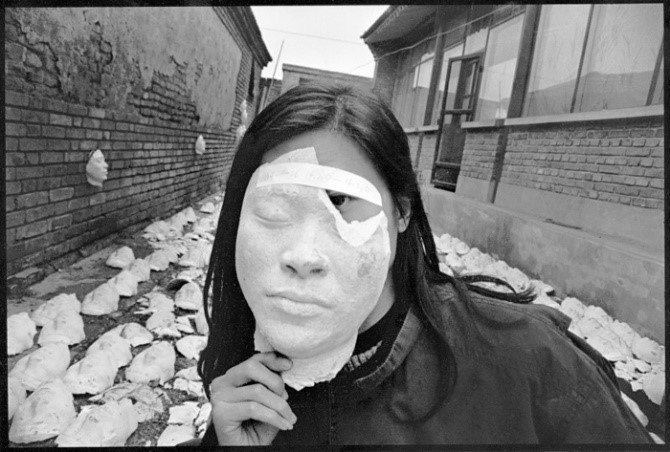
I delved into contemporary photography in China by studying Rong Rong’s East Village series, which tackles provocative and impactful themes in post-Cultural Revolution China.
Rong Rong’s East Village
Rong Rong’s East Village is the title of both the photographic series and the book by avant-garde Chinese artist Rong Rong. This book, which inspired this article, resulted from a lengthy selection process involving the collaboration between Rong Rong, curator Wu Hung, and gallerist Christophe W. Mao. It was published in 2003 to coincide with the exhibition of the same name at Chambers Fine Art in New York.
Chinese art in the mid-1990s benefited from the socio-economic transformations impacting the country. After the stability achieved with Mao Zedong’s Cultural Revolution, which ended in 1976, China entered a phase of change. The ruling political class adopted a new market economy, opening the country to foreign trade and cultural influences that had previously been staunchly rejected.
As a result, official propaganda photography began to be abandoned, and the first experimental artists, eager to escape institutional control and censorship, started to pursue independent artistic paths.
Cultural historical context
In the mid-1980s, the first avant-garde artistic movement, known as the ’85 New Wave, emerged across various Chinese provinces. By the early 1990s, artist villages began to flourish, notably Yuanmingyuan, the epicenter of Chinese experimental art, and Songzhuang, where artists occupied abandoned villages on the city’s periphery.
Artistic hub
The East Village(Dongcun) became an artistic hub in 1992. Resembling the desolate European suburbs of the 19th century, this environment inspired artists to embrace a conscious exile. The East Village experience ended in 1994 when arrests led to the evacuation and eventual demolition of the village.
Rong Rong, who began his photographic journey in 1988, moved to the East Village to escape Beijing’s solitude and find a community. He documented the village’s performances and formed significant friendships with artists like Zhang Huan, Ma Liuming, and Duan Yingmei. Rong Rong’s time in the East Village was cut short by police raids and accusations of obscene acts, marking his first experience with political persecution.
Rong Rong’s East Village series was created in just one month, from May to June 1994, focusing on documenting performances and artistic actions. Notable works include Zhang Huan’s 12 Square Meters and 65 Kilograms, which gained international recognition through Rong Rong’s and Ai Weiwei’s photographs. In 12 Square Meters, Zhang Huan is suspended in the air, chained to the ceiling. Rong Rong’s use of unexpected angles and dramatic contrasts transforms the chaotic performance into dreamlike images, adding new dimensions to the artist’s vision.
Artists new role
The new role of the artist, independent of political power and conscious of their freedom of expression, is central to contemporary Chinese art.
Given China’s recent Maoist Cultural Revolution, antagonistic to dissent, it’s unsurprising that artist villages were often accused of creating extreme works and faced political persecution.
In this context, photography became a crucial medium for self-representation and a valuable testament to the fight for fundamental civil rights.
Read my article
Rong Rong’s East Village [ITA]: http://www.ikonemi.org/rong-rong-east-village/
 Ilaria Di Gregorio